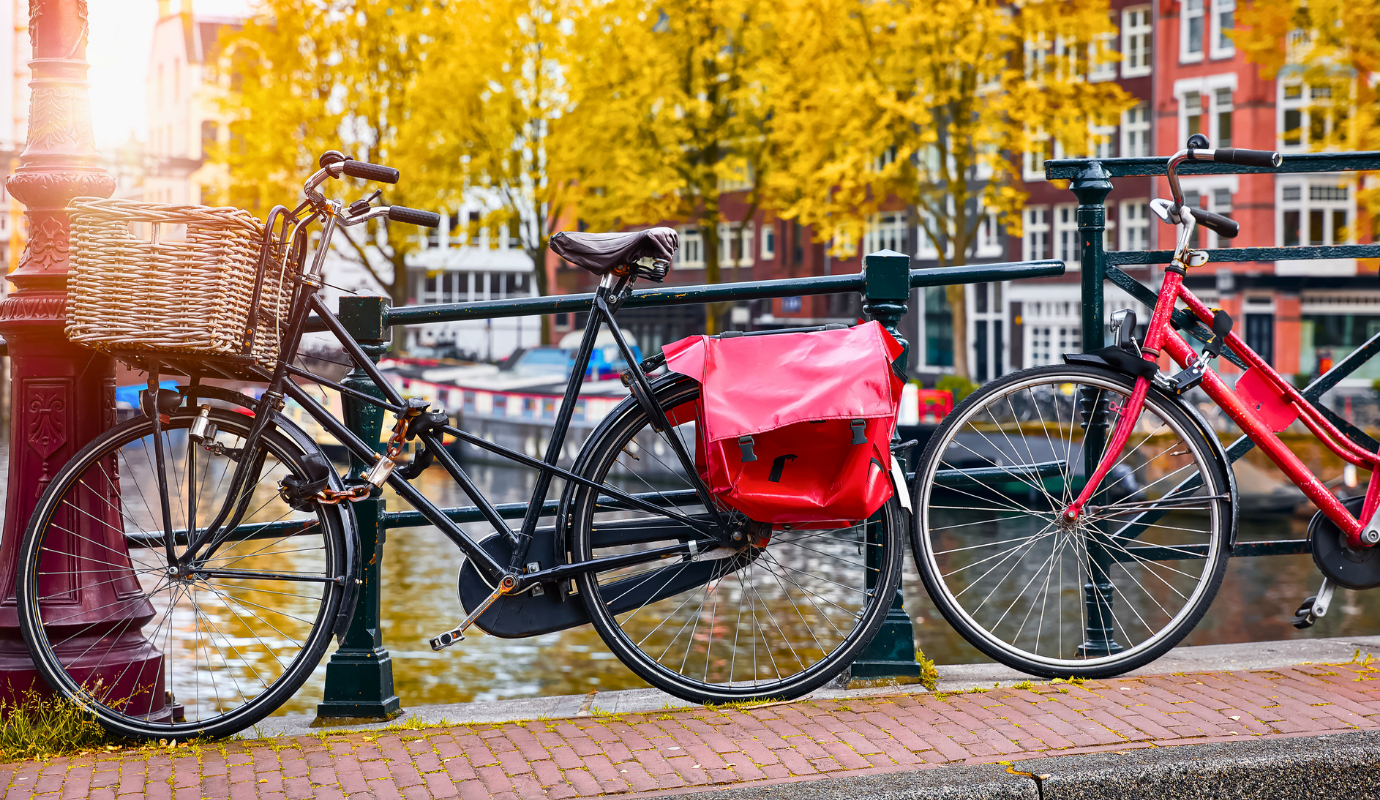
Getting around the Netherlands feels so easy when you spend your first couple weeks here. Everything seems close, well connected, and surprisingly manageable (even without a car).
But with so many options available, it can feel a bit overwhelming. Bike? Train? Tram? The answer is that getting around the Netherlands usually means combining a few of them. Here’s a breakdown of what works, when, and for who.
Cycling: the Dutch Way of Life
If you want to feel like a real local from day one, get a bike.
In cities like Amsterdam and Utrecht, cycling is often the fastest way to get around. The infrastructure is built for it, because you have dedicated bike lanes everywhere, traffic lights timed for cyclists, and parking racks at every corner.
But be aware: it might take some time to get used to it. Bike lanes can get busy, and locals cycle with confidence and speed. You’ll share the road with commuters on regular bikes, e-bikes, heavy cargo bikes, and the popular fat bikes. During rush hour especially things move fast and everyone knows what they’re doing (except you). Give yourself a few days to adjust and don’t be scared.
One thing worth knowing: always use lights after dark, follow the local traffic rules, and give extra space to larger or faster bikes. It sounds obvious, but it’s easy to underestimate how quickly things move on a busy bike lane.
Best for: short distances, city living, flexible schedules
Trains: Your best friend for longer commutes
Living in one city and working in another? This is where the Dutch train network really earns its reputation.
Trains run frequently, are (mostly) easy to navigate, and connect all major cities efficiently. Rotterdam to Amsterdam takes under an hour. The Hague to Utrecht is about 40 minutes. For many expats, the train becomes a daily routine rather than an occasional trip.
To use the train, and most other public transport, you’ll need an OV-chipkaart. It’s a reusable travel card that works across trains, trams, buses, and metros nationwide. You check in and check out at every stop, and the fare is automatically deducted. You can get one at any major train station or order it online via the OV-chipkaart website.
Best for: Intercity commuting, longer distances
Trams, buses & metro: filling the gaps
Once you arrive at your destination, local public transport takes over.
Trams, buses, and metro lines are especially useful if your office isn’t right next to a train station, or if cycling isn’t your thing. In larger cities everything is well connected, and switching between transport modes is straightforward – all with the same OV-chipkaart.
Best for: inner-city travel, the first and last part of your commute
Driving: convenient (but not always practical)
In Dutch cities, commuting by car is often more stressful than it’s worth. Traffic, limited parking, and high parking costs make it less appealing. That’s why most people living in city centres rely on bikes or public transport instead.
If you live outside the city or have irregular working hours, having a car still makes sense. You’ll also find Park and Ride (P+R) options around cities like Amsterdam and Utrecht – affordable parking just outside the city where you switch to public transport for the last stretch. It’s a good middle ground if you want to avoid driving into the centre entirely.
Best for: rural areas, flexible or irregular schedules
The real Dutch commute: mixing it all
Most people don’t stick to just one option.
A typical commute might look like: bike to the station, train to another city, tram to the office. It sounds like a lot, but getting around the Netherlands this way is surprisingly smooth once you know the system. Within a few weeks most expats find a routine that just works.
Start simple. Try cycling for short distances, use the train for longer ones, and don’t be afraid to combine options. You’ll figure out what works for your situation!
Want to read more?
For more resources and insights, visit our blog. You can also follow us on Facebook, Instagram, and LinkedIn to stay informed on everything we share.